
Understanding Tongue Tie
What parents should know about tongue function, treatment options, and recovery
What is a tongue tie?
A tongue tie (ankyloglossia) occurs when the band of tissue under the tongue (the lingual frenulum) limits normal tongue movement.
The important question isn’t “Does my baby have a frenulum?” (everyone does.)
The important question is:
“Can my baby’s tongue move well enough to feed comfortably and effectively?”
As an IBCLC, I’m looking at tongue function, not just what the frenulum looks like.
How does tongue function affect feeding?
A baby’s tongue needs to:
✓ lift to create suction
✓ maintain a seal
✓ extend over the lower gum
✓ cup around the breast or bottle
✓ move rhythmically to remove milk
When tongue movement is restricted, babies often compensate by:
- biting with the gums
- using the jaw instead of the tongue
- losing suction
- swallowing excess air
- tiring during feeds
This is what optimal tongue function looks like: https://www.youtube.com/watch?v=x4noyrLrp5Q
This is what ineffective tongue function looks like: https://www.youtube.com/watch?v=YuuZhfqFKPE
Common Signs of Tongue Tie
PARENT
- nipple pain
- cracked, blistered or bleeding nipples
- lipstick-shaped nipple after feeds
- recurring plugged ducts
- mastitis
- recurrent thrush symptoms
- compromised milk supply
- needing to pump after feeds
- very frequent nursing
- exhaustion because baby never seems satisfied
BABY
- difficulty latching
- clicking
- leaking milk
- popping off to breathe
- choking or coughing
- gassy
- reflux-like symptoms
- colic
- poor weight gain
- frustration at the breast
- preference for bottles
- lip blisters
- heart-shaped tongue
- bubble/high palate
- excessive drooling
- persistent white “milk tongue”
Having one or even several of these signs does not automatically mean your baby has a tongue tie. These symptoms simply help us decide whether further evaluation is appropriate.
Is it always a tongue tie?
Not necessarily.
Many babies have:
- body tension
- birth-related muscle tightness
- torticollis
- oral motor immaturity
- positioning issues
- fast or slow milk flow
…and these can look remarkably similar to a tongue tie.
Sometimes they occur together.
That’s why I recommend looking at the whole baby, not just under the tongue.
Should every tongue tie be released?
No.
A release may be appropriate when:
✔ feeding remains difficult despite good support
✔ milk transfer is poor
✔ pain continues
✔ tongue restriction appears to be limiting function
Sometimes:
- time
- feeding support
- positioning
- oral exercises
- bodywork
are all that’s needed.
Preparing & What to Expect
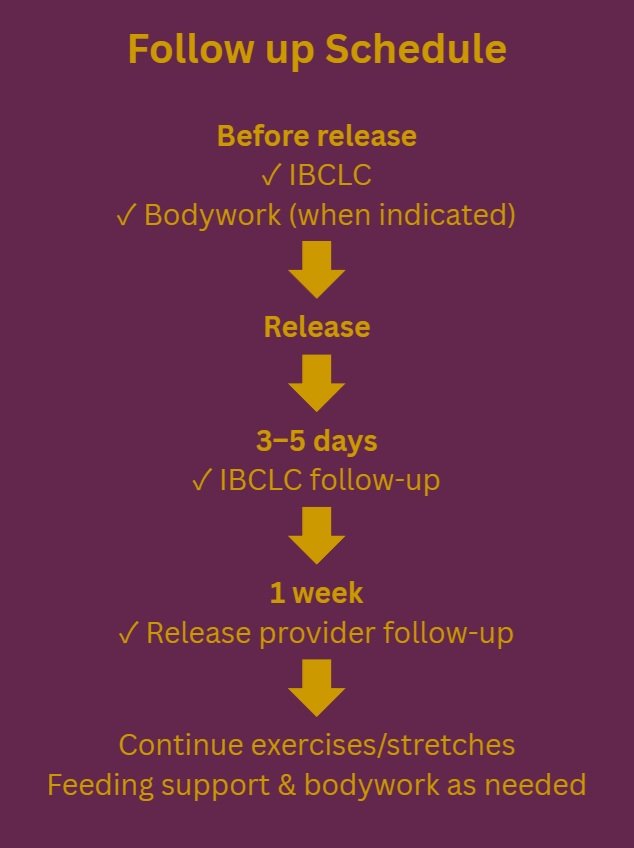
BEFORE RELEASE
✓ Work with an IBCLC
✓ Begin oral rehabilitation exercises (2–4 times/day)
✓ Consider bodywork if significant body tension is present or birth interventions occurred
✓ Learn what to expect after the procedure
DAY OF RELEASE
The procedure itself is usually very quick.
Many providers ask parents to wait outside the treatment room.
Laser procedures often require only seconds to complete.
Most babies calm quickly afterward and are encouraged to feed immediately.
⭐ DON’T BE SURPRISED IF YOUR BABY HAS A DIFFICULT EVENING.
Many babies experience their hardest period about 5–6 hours after the release.
This may be related to soreness, muscle fatigue, or simply learning to move the tongue in a completely new way.
During this time your baby may cry more, seem unusually fussy, or refuse to latch temporarily.
Things that often help:
- skin-to-skin
- babywearing
- rocking
- going outside
- warm bath or co-bathing
- patience
Avoid assuming the release “didn’t work.”
Tomorrow is often a better day.
Recovery & Aftercare
A release removes the restriction, but is not a magic cure and doesn’t automatically teach the tongue how to move.
Think of it like physical therapy after knee surgery.
The surgery creates the opportunity for better movement, but practice and rehabilitation help the body learn to use that new range of motion.
The first 6 weeks after a release are where we do two things:
1. Prevent the wound from healing back together
2. Teach the tongue how to move properly
ORAL EXERCISES
Exercises given by IBCLC to teach the tongue how to move
Do these:
- before release
- after release
- 2–4 times/day (start before release and continue 4-6 weeks post-release or as determined with IBCLC)
- while baby is happy
- make it playful
These help improve tongue coordination, create positive experiences and reduce oral defensiveness.
STRETCHES
Preventing the wound from healing back together.
Typical schedule:
- One stretch the evening of the procedure
- Skip overnight the first night
- Then 6 times/day
- No more than six hours between stretches
- Continue for approximately four weeks
- Remove one session per day during week four
Use singing, smiling, talking and distraction to help keep the experience as positive as possible.
Wound Care Demonstration Videos:
- Demo w/Puppet – https://vimeo.com/518192415
- Lip Wound Care (first 10 sec of video) – https://vimeo.com/98709935
- Tongue Wound Care – https://vimeo.com/255055551
Frequently Asked Questions
Who treats tongue-tie?
As IBCLCs, we are not here to diagnose or release a tongue tie. We are, however, trained in identifying them, understanding their impact on breastfeeding, and making appropriate referrals.
Tongue-ties can be treated by scissors or laser.
Frenotomy:
- The frenulum is clipped with scissors.
- Anesthesia is not typically required.
- It can be done by pediatricians, pediatric ENTs, credentialed nurse practitioners, and pediatric and general dentists.
- Babies can nurse directly after the procedure.
Frenectomy:
- The frenulum is released with a laser.
- Anesthesia is not usually required.
- A pediatric or general dentist typically performs the procedure.
- Babies can nurse directly after the procedure.
What can I use for pain relief?
Not all babies require pain relief assistance, but for those who do:
- Acetaminophen (Tylenol), if recommended by your provider
- Some families choose to use Arnica 30C or Rescue Remedy for Kids as homeopathic options
- Coconut oil after stretches
Is my baby’s tongue tie reattaching?
Wound contraction can happen around days 3-5 (also sometimes around days 7-10 and day 21). This is a natural part of healing and different from reattachment. You may notice the wound turn white or yellow, and the wound feels harder to elevate and baby is more resistant to wound care. Latch pain may return or it may seem like baby’s symptoms are returning. It should resolve and continue getting better after a few days.
Reattachment is different than wound contraction and is when the tissue comes back together causing new restriction of the tongue and a persistent return of symptoms. If you are concerned with reattachment, it is best to be seen by the release provider or your IBCLC right away.
In the case of early reattachment, you may be interested in trying to restore mobility by using topical serrapeptase. Discuss this with your IBCLC:
- Serrapeptase is an enzyme that breaks down proteins like fibrin, which is involved in blood clotting. It has anti-inflammatory properties and may help reduce pain and swelling.
- Order: https://www.amazon.com/Arthur-Andrew-Medical-Serretia-Serrapeptase/dp/B006ZIH482?th=1
- Serrapeptase info: https://www.ncbi.nlm.nih.gov/pmc/articles/PMC7032259/?fbclid=IwAR02NB6yGCElZ5RfBuOmHxcKr9iwibOf6oyqXdSgczo55t00HIHYl-M3ICw
Additional Resources
Breastfeeding improvement following tongue-tie and lip-tie release – A prospective cohort study: https://onlinelibrary.wiley.com/doi/full/10.1002/lary.26306
Several articles by Dr. Ghaheri, an ENT who has released more than 17,000 tongue ties: https://drghaheri.squarespace.com/downloads/
Dr. Ghaheri’s aftercare explanation: https://www.drghaheri.com/aftercare